
Experience beginning 2021
Veteran’s Day Ceremony addresses need for empathy for veterans; honors veteran’s for devotion
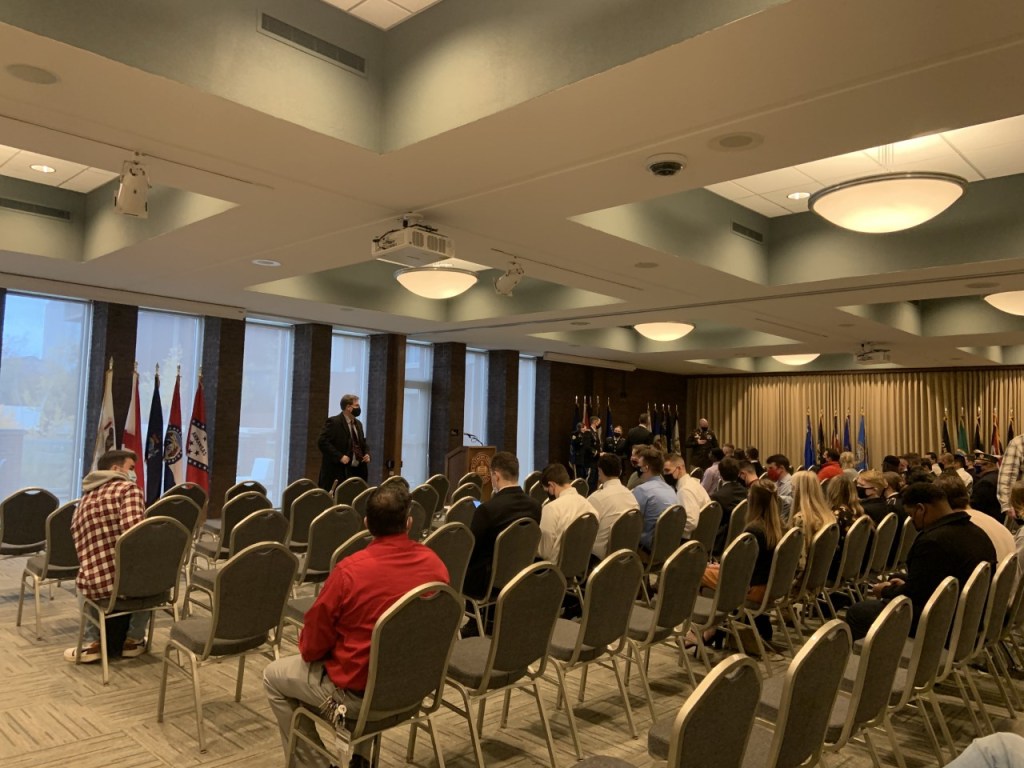
The Illinois State University Veterans Day ceremony on Thursday honored past and current military personnel for their service and commitment to defending the United States. The ceremony also addressed the mental health struggles that many veterans endure.
The ceremony began at noon on Thursday in the Prairie Room of the Bone Student Center and featured guest speaker retired Lt. Col. John Cross. Cross also served as the program director and as a professor for military science.
“If you find yourself in that dark spot, and if you feel that there is no other way to deal with what’s going on – the pain and the anguish – the last thing you should really consider is to end it all,” Cross said. “What you should do, instead, is reach out to your battle buddy. Reach out to that bunkmate. Reach out to that person who you had that you bonded with in your time in the service because they know what you’ve gone through, and they can be there for you. That’s a commitment that we as veterans should have for each other.”
Cross also said civilians can honor veterans by being a listening ear. He went on to say that while civilians will not understand from a personal experience what veterans have endured, being empathetic and listening could potentially save someone’s life.
“The light that you provide in that moment may be the light that that person needs in order to guide them out of the dark spot that they’re in,” Cross said.
Cross also encouraged all veterans to become involved with their local veterans’ organizations to build community with others who have similar experiences.
President Terri Goss Kinzy thanked all veterans and active duty personal in the military, both at ISU and across the country and world, for their service.
“Their faithful service to this nation cannot be underestimated, and we’re truly grateful for the service that you have rendered and the sacrifice you that have made for all of us,” Kinzy said.
Veterans and Military Services, ISU ROTC, Veterans at Illinois State, Omega Delta Sigma and the Office of the University Registrar organized the ceremony.
How a passion for knowledge has guided one man’s life
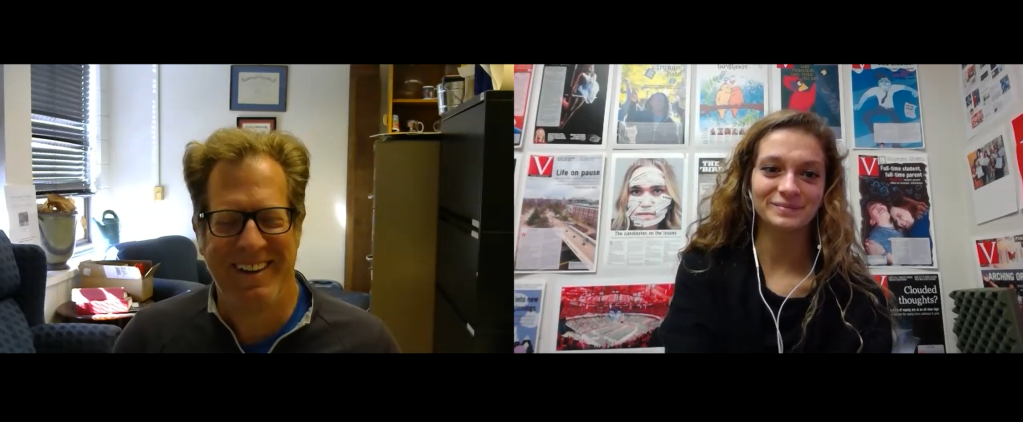
The COVID-19 pandemic took the world by surprise causing live altering heartbreak. For some, they were able to flourish in new paths and directions despite the challenges.
Paul Garris was not expecting to become the Illinois State University COVID-19 testing site coordinator in May, but he stepped up to fill this important role.
“It’s been daunting and overwhelming at times. I’ve had to learn an entirely new skillset. For over 25 years, I’ve been a scholar and an educator at ISU,” Garris said.
Some of Garris’ responsibilities as the testing sites coordinator include overseeing operations of the COVID-19 testing lab and the sample collection sites, making decisions on personnel issues, filling orders and interacting with entities off campus that support the COVID-19 testing lab and the collection sites.
“There’s really no manual for this job. I really must figure out, ‘What do I do?’ ‘How to do that in the best way that I could?’” Garris said. “So, it’s exciting to have so much freedom. It’s also daunting that you have so much responsibility too.”
Garris said that even with the challenges, he still finds fulfillment in this position.
“I know we’re providing a needed service to Illinois State, and we have a lot of other clients outside of Illinois State throughout the state. I’m fully aware of the importance of that service, so that gives me a lot of pleasure thinking about that,” Garris said. “It makes me very proud, and I think we’re doing a good job, so that also makes me very proud. In 10 years from now when the pandemic is over, hopefully, I’ll look back and think, ‘Wow. What an exciting enterprise that I was a part of.’ I think I’ll be even prouder and happier for being involved in this.”
Since 1995, Garris has taught a variety of biology courses at ISU. Recently, Garris has taught neuroscience and physiology courses.
In addition to being a professor, Garris runs a research lab and studies the brain mechanism of drugs of abuse. Specifically, he focuses his studies on the use of amphetamine, a highly addictive drug that is used clinically to treat ADHD.
However, Garris did not begin his journey to becoming a biology professor like most. He earned his Bachelor of Arts degree in religion even though he intended to study biology during his undergraduate studies.
After growing up with a father who was a minister, Garris was curious about what his small liberal arts college had to offer. One by one, he took religion class after religion class until he approached his senior thesis and comprehensive exam. At this point, he had completed an entire degree.
“The religion [studies] was an intellectual passion of mine. I still wanted to be a scientist when I graduated” Garris said. “I think what my theology training did was it taught me to read and think. I do that as a scientist, and I do that for all kinds of things. It was good intellectual training in that regard.”
When he finished his Bachelor of Arts in religion, he had also fulfilled enough biology, physics and math courses to apply to graduate school. He earned his doctorate in physiology and then did postdoctoral training in analytical chemistry.
Now, Garris balances many responsibilities at ISU, and while he chuckled and said he does not get enough sleep, he also said his team in the research lab at ISU is excellent to work alongside.
One member in particular, Kim Garris, is also Garris’ wife. For 15 years, she worked as the technician in his research lab.
“I feel like we’re getting the band back together for the COVID-19 operations,” Garris said. “It’s an army that’s pulling this off, and it wouldn’t happen without all these really great people working together with a lot of expertise and the willingness to help.”
In addition to working with an excellent team, Garris said his family keeps him grounded with such a busy schedule.
Since beginning his studies and eventually his career as a scholar and an educator at ISU, Garris said he has obtained a growing passion for intellect. One of his hopes for all his students is that they, too, will enjoy their experience in the classroom or in the lab while also learning about neuroscience, physiology and research.
“I want students to acquire that passion for research and for that project. There’s’ nothing more that makes me happy than to see one of my former graduate students go off and do what they want to do. It could be they may go teach at a smaller school or become a researcher at a big school, or any combination of those things,” Garris said. “When they follow their passion and they’re successful at it, that makes me feel like I’m a success.”
Garris may look to retire from ISU within the next couple of years. He said no matter what happens, he plans to never stop reading and learning both in biology and beyond to grow his passion for knowledge.
ISU president Kinzy gives State of the University Address, combating past challenges and progressing forward
The 20th president of Illinois State University and the first female president gave her first State of the University Address. President Terri Goss Kinzy aided ISU in its return to an in-person semester after sixteen months of online classes for most of the ISU community, and her one of her goals leading into the fall semester was to create a safe environment for ISU despite the challenges of COVID-19.
The event began with a warm welcome from Senate Chair Martha Horst at 2 p.m. on Tuesday at Concert Hall of the Center for Performing Arts.
Horst said after a year and a half of being online, ISU is back to a “true Redbird experience.”
“The pandemic made it hard for the academic senate to do its most basic parts of shared governance. Yet the academic senate held its own,” Horst said. “We are back in person, and we are back in business. I am confident that ISU’s strong tradition of shared governance will continue, especially given our current administration.”
Kinzy took the stage and thanked the academic senate, students, faculty, staff, alums and friends of ISU for their support and efforts that have impacted ISU during the COVID-19 pandemic. Kinzy highlighted many lessons that ISU learned, such as becoming more effective collaborators, leveraging technology to learn and teach in new ways, the value of virtual programs, experiencing traditions in new ways as well as continuing to utilize creativity and innovation to offer services to students.
“Even in the midst of a global pandemic, Illinois State accomplished amazing things. We have much to be proud of as we emerge from COVID-19, a more resilient institution and one that is in position for the future,” Kinzy said. “It’s our success for adapting to these changes that could not happen without the dedication of our faculty and staff across campus who continue to work tirelessly to provide a safe environment for all.”
Kinzy said without these efforts, ISU would not be able to remain devoted to its mission of teaching, learning and scholarship during this extraordinary time. Higher education was redefined during the pandemic, and ISU still proves to be successful despite the challenges it endured.
“Success is not just numbers. Success is also harder to quantify but a critically important factor of excellence. From a student or faculty whose work of art truly moves people. To the joy that the Gamma Phi Circus provides to our community. Excellence is what we are known for,” Kinzy said. “Defined by a continued commitment to the future and our pursuit of excellence, we build that future strategically creating a holistic approach shaped by our values and our vision.”
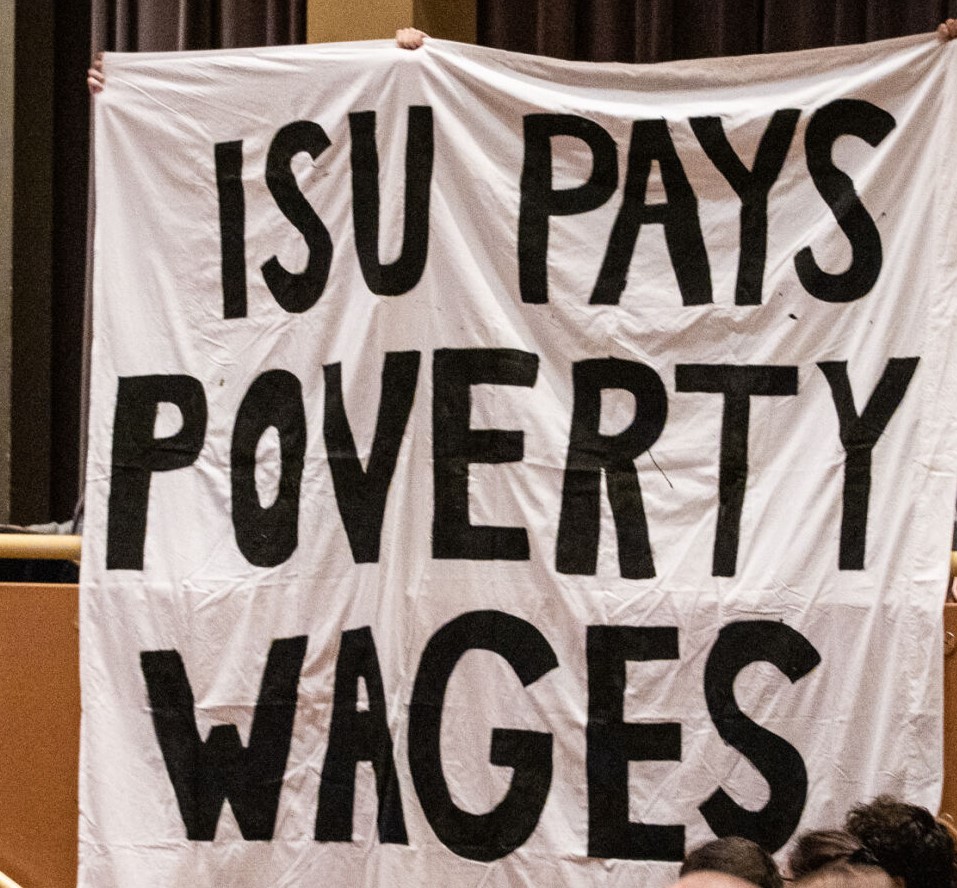
Around halfway through the state of the address, a handful of members of ISU’s graduate student worker union stood up from the crowd and held up a banner reading, “ISU pays poverty wages”. The state of the address continued without interruption, but the banner was held up high throughout the entire remaining fifteen minutes of the event.
In her address, Kinzy also focused on how to define ISU’s past success and spoke of ISU’s various awards, increasing enrollment rates, financial aid provided to students, academic programs, funding and athletic achievements.
“Excellence is what [ISU is] known for these amazing milestones in the last year under incredible circumstances, mark our path, but find by continued commitment to the future and our pursuit of excellence,” said Kinzy. “We build that future strategically, creating a holistic approach shaped by our values and our vision.”
Kinzy wants to secure better state funding for ISU. Currently, ISU is the lowest funded public university in Illinois, 43% behind the second lowest funded university.
Though ISU has been strategic about saving money during the COVID-19 pandemic and has received federal and state aid, only 65% of interest paid in COVID-19 expenses, lost revenues and refunds will be covered. In total, ISU lost $25 million because of the pandemic.
However, ISU has persevered in combating the impact of the pandemic.
As of Tuesday, 92% of faculty and staff are vaccinated, 83% of students living in university housing are vaccinated and 76% of all students enrolled are vaccinated.
Over $90 million in financial aid was given out to students last year, and 89% of students were awarded a grant or scholarship.
“At my core, I am a scientist. That might make you think that I am dogmatic or driven only by numbers or results. But science is holistic exploration. It is a belief that building strength comes from questioning, from forming hypotheses, from experimentation and from collaboration and teamwork,” Kinzy said. “May I add a function of hope. A steadfast optimism that in every endeavor is an opportunity to get it right or to grow and try again.”
From 2018 to 2023, ISU committed itself to the strategic plan to educate, connect and elevate. Kinzy said that moving forward, she is devoted to this plan as the university navigates any and all obstacles thrown in its way.
“I come back to that question of ‘what is success?’ Awards, numbers, wins … those accolades are well earned and wonderful, and we will celebrate them. Success for Illinois State will come from creating an environment that allows for innovation, exploration, and identity to flourish,” Kinzy said. “There will always be work to do. As we keep in mind that there is much to be done, let us remember to celebrate what we have accomplished.”
ISU journalism student Ashley Daniels attended the state of the address, and she said she enjoyed how informative Kinzy’s speech was.
“It definitely used facts and statistics, which is very important because that’s the only way we can really see a difference if things are getting better or decreasing in value,” Daniels said. “I felt like the address was well needed, and I thought it was great honestly.”
Daniels said this was her first time attending a state of the address. She wishes that Kinzy would have mentioned more COVID-19 safety precautions beyond mask wearing and social distancing that Kinzy is implementing on campus to protect faculty, staff and students.
DACA recipient and artist Fifield-Perez explained his experience with DACA through his artwork at the “Legalities of Being” event

Artist and Deferred Action against Childhood Arrival recipient Fidencio Fifield-Perez makes sense of the last ten years of U.S. immigration policy and his experiences with DACA through his artwork.
After two years of rescheduling the “Legalities of Being” event given the COVID-19 pandemic, Fifield-Perez spoke at 7 p.m. on Wednesday, Sept. 15 at the Normal Theater as part of Illinois State University’s LatinX Heritage Month celebration.
From the perspective of Fifield-Perez, the phrase “legalities of being” is a way to navigate the U.S. immigration system and prove that he too exists in a world where he has been forced to hide from the U.S. government.
“Sometimes I feel like it is not enough to exist because the government is continuously telling us that we are either ‘legal or not legal,’ making us go through hoops, applying for DACA every two years. It really does, at some point, start to question the legality of who we are in a fundamental way that I think is not healthy,” Fifield-Perez said.
At the age of seven, Fifield-Perez immigrated to the United States from Mexico to escape the injustices his family was enduring, but much of his childhood consisted of constant fear of deportation given his undocumented status. It wasn’t until Obama’s presidency in 2012 when DACA was introduced to children like Fifield-Perez.
“It was so strange to see myself represented. When he [Obama] got on stage, I couldn’t control the tears that fell. This was the first time I would be able to have a law made for me,” Fifield-Perez said.
According to Fifield-Perez, DACA is not amnesty. Every 1.8 years, he and his siblings must reapply to receive DACA, and all costs are paid out-of-pocket.
In many of Fifield-Perez’s artwork pieces, he incorporates images of maps and brown bodies. His artwork gives him an outlet to process heavy issues relating to politics and law, such as the Supreme Court debating the legality of DACA and how this impacts millions of lives.
“You should be able to look at the work and see immigration in a larger aspect than just brown bodies. When it relates to the border, we share so many images of dead brown bodies,” Fifield-Perez said. “I’ve never seen a dead white body in the news, I never want to, but we should apply that same dignity to brown bodies.”
Fifield-Perez went on to say his practice has always coincided with immigration law. More recently, he has focused on not only his experiences as an immigrant and a DACA recipient in his artwork, but he has sought to tell the stories of immigrants who were less fortunate than Fifield-Perez – those who did not survive beyond the long journey of crossing the border or who did not become accepted into programs like DACA.
Fifield-Perez said he cannot separate his artwork from his DACA experience because without DACA, he would not have the liberty to travel and have a practice as an artist and a professor.
Visit Fifield-Perez’s website to view his artwork.
The New Star Ginger Restaurant Wins ISU Students’ Favor
Star Ginger Fresh Asian Flavors, created by award-winning chef Mai Pham, is now open for lunch and dinner on the second floor of the Bone Student Center at Illinois State University. The new restaurant opened at 11 a.m. on Feb. 18, and it was an instant hit with its combinations of fresh ingredients and traditional Vietnamese dishes. Star Ginger is open Mondays through Thursdays from 11 a.m. to 8 p.m. and on Fridays from 11 a.m. to 7 p.m. It is closed on Saturdays and Sundays.
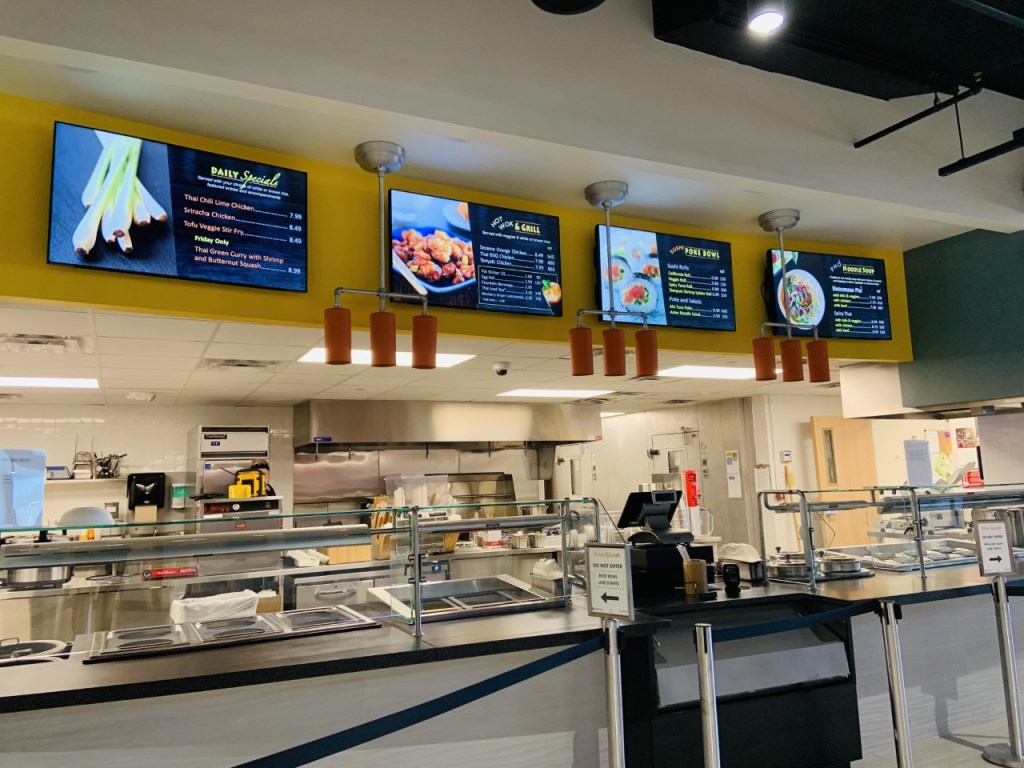
Lunch and dinner rushes filled the Bone Center and kept the Star Ginger employees busy between opening day, Wednesday Feb. 18, and the following Thursday and Friday. Food and Sanitation Laborer and Star Ginger employee Mike Johnson said that tons of ISU students formed long lines throughout the Bone Center due to their excitement about the opening of the new restaurant. He said that of all the items on the menu, teriyaki chicken and the Thai barbeque chicken were the most popular on opening week.
“It’s been a positive experience. The food is good, and it’s a change from what we have already,” Johnson said. “It’s a little bit of stumbling along at first, but that happens when opening a new restaurant.”
Many students at ISU said that they would recommend Star Ginger in comparison to other Asian food options in the Bloomington Normal area because of its authentic and savory meals served right on campus. Star Ginger locations are known for their wide variety of dishes. Customers can expect authentic menu items such as stir fry rice bowls, Vietnamese pho, sushi rolls, Thai chicken, fresh salads and more. Vegetarian and gluten-friendly options are also available.
Psychology student Stephanie Gabrila said, “I thought it was pretty good. I got the orange chicken and white rice, and the orange chicken was more on the sweeter side.”
Gabrila also said that she would recommend that her friends try the Vietnamese restaurant because it is a lot different than any other option at the Bone Student Center. On the second floor alone, there is a Qdoba which serves Mexican food, and Timbers Grille serves burgers and several types of American food. Joining these restaurants in the Bone Student Center is Starbucks, The Landing, and McAlister’s Deli. Star Ginger is therefore the only Pan-Asian restaurant located on campus.
ISU students and faculty can call the Bone Student Center at 309-348-7827 for more information about Star Ginger. All food will be packaged and served to-go. Star Ginger accepts cash, card, redbird card and flex dollars.
Nursing Students Distribute COVID-19 Vaccinations for Clinical Hours
Illinois State University nursing students are gaining experience in the medical field by distributing vaccines at university vaccination clinics.
Part of nursing students’ training involves clinical rotations in different healthcare settings. Vaccine clinics at the Bone Student Center present an opportunity to apply concepts from the classroom to the outside world.
Eric Jome, director of media relations at ISU, says many vaccine clinics since January were successful because of the efficient vaccine distribution systems and the help from students.
“Having them be a part of that is certainly very helpful for our efforts here on campus. The more people that are qualified to give injections, the more people we can move through vaccine clinics.”
Jome says that this generation of students in nursing and allied health fields will always remember their experience on the frontlines during the Coronavirus pandemic.
Bradley University also provides educational opportunities for their nursing students to participate in distributing vaccines.
While some worry that nursing students distributing vaccines puts them at risk, nursing students Eva Churchill and Claire Feld at Bradley University say that they wish they had the opportunity to participate in distributing vaccines, but they have not yet started clinical rotations.
“I don’t think they are just because there are a lot of precautions set in place and a lot of the students are already vaccinated themselves.”
“If you’re already vaccinated yourself, I’d feel less at risk than if I wasn’t.”
While Bradley University does offer vaccination experience for nursing students, their vaccination locations are off-campus contrary to ISU’s on campus experience.
Many vaccination clinics will follow in April with recent eligibility expansions at surrounding universities.
The Coffeehouse and Deli’s Expansion in Hours
The Coffeehouse and Deli in Uptown Normal expanded their hours to bring in more clientele as springtime and warm weather approach Central Illinois.
As of April 5, the Coffeehouse is open daily from 7 a.m. to 6 p.m. seven days a week, and the kitchen closes daily at 4 p.m.
Previously, the local coffee shop was open until 4 p.m. during the winter months.
The expansion in hours gives customers more time to enjoy a meal, complete their work and hang out at the shop.
ISU Communication and Organizational Leadership student Kristine Loughery says that the coffeehouse has been a home away from home during the last four years she’s spent at Illinois State University.
“I think it’s a great thing. I came here today to try work on a paper all day, and I thought they closed at four. So, the extra two hours will definitely help me.”
Loughery’s online classes have been rigorous since the beginning of the pandemic, and she says doing homework alone in her apartment is depressing.
She comes to the Coffeehouse in Uptown often to not only enjoy their sandwiches and coffee but to have more human interaction.
The Coffee house and Deli in Uptown is known for vegetarian and vegan cuisine along with their fresh coffee. Latella and other baristas say the food is unique and affordable, and there is great variety among breakfast and lunch specials.
Since 1996, the Coffeehouse in Uptown has celebrated the Bloomington, Normal community by providing both an indoor space and an outdoor space for customers to gather.
Coffeehouse and Deli Barista Mollie Latella says working at the coffee house is a great environment. The expansion in hours gives her more opportunities to see regular customers, and Latella says there is something comforting in the fact that the same people visit the coffee house throughout the week.
Latella says that while the pandemic has been difficult on this shop and seating was at times limited, it is still standing with a welcoming atmosphere ready to serve the community.
“It was really just because we started to see a lot more business since COVID-19 first started. A lot more people have been coming in, especially on the weekends, and my boss just made the executive decision to re-extend the hours.”
With extended hours, you can visit the Coffeehouse and Deli in uptown Normal today to enjoy a variety of coffee drinks, meals and local art featured at the shop.
ISU Students Prepare for the End of the Semester
The Vidette Newspaper at ISU Switches to Online Format for Future Semesters
The Vidette newspaper at ISU is transitioning to a digital format for future semesters given the growing success on Twitter and on their website.
Two years ago, the Vidette published a newspaper twice a week, and within the last year, the Vidette was only publishing a newspaper once a week. Vidette staff and interns notice the decline in newspapers being read on campus, and so they are choosing to only publish stories online.
Andrea Ricker, ISU journalism student and features sub-editor at the Vidette, says tens of thousands of members of the community view the website, and many Vidette stories have gained a lot of traction on Twitter within the last year.
“I’m personally not super concerned with it because I think people know us. We’re not going away. I think we’re just going to come back, like, stronger than ever. We’re still going to make our voice heard. We’re still going to be on social media. We’re still going to be doing it.”
Ricker says that she felt stressed in the days leading up to the final production because she wanted her page to be perfect. Now that the paper is completed, the editorial staff is pleased with the outcome.
The final edition of the newspaper includes sixteen pages that were planned carefully over the course of the last month by general manager John Plevka and the editorial staff.
In the newspaper, there is an editorial from the Editor in Chief, stories from various reporters, an ISU sports timeline and an entire page devoted to thanking the ISU community for its support of the newspaper over the last 133 years.
Grace Kinnicutt, ISU journalism student and Vidette news editor, says one of the most surreal moments was when Plevka edited her page for the last time on the final production day. Plevka greatly impacted Kinnicutt and other Vidette staff throughout each semester.
“I could not imagine being a part of the Vidette without JP because I have never met anyone more passionate about wanting these students to become great journalists and just wanting to exceed expectations far and wide.”
The final edition can be found at several locations on campus, such as at Milner Library and at the Bone Student Center. In addition, many local businesses in Normal also have copies of the newspaper for community members to read.
The Vidette is devoted to providing content online and through social media during the rest of this semester and in the future. Ricker and Kinnicutt say that while it’s heartbreaking to see the print aspect go, they are excited for the community to pay attention to the digital stories and articles, and they hope viewership grows in the coming months.
West Virginia Governor Justice Grants Incentive to young COVID-19 Vaccine Recipients
OPINION
The Coronavirus pandemic has been a topic of controversy since Trump declared that “the democrats were politicizing it” in 2020. Now, many Americans are refusing to become vaccinated. While encouraging citizens to become vaccinated is important if our world is to achieve herd immunity, not every incentive is valid.
The New York Times published an article on April 26 stating that Governor Jim Justice of West Virginia will be giving $100 savings bonds to 16 through 35-year-olds who get the Coronavirus vaccine. According to Justice, thousands of individuals in this age category are not getting the vaccine as quickly as West Virginia officials were hoping, and the CARES Act funded savings bonds will serve as an incentive to become vaccinated. Justice and other officials are desperate to stop the rise of Coronavirus cases as West Virginia is now ranked the 16th highest state in the nation to have COVID-19 outbreaks (Pietsch).
Justice should not be offering $100 savings bonds to individuals receiving the vaccine. First, other states are not providing incentives for young adults to become vaccinated. Simply put, it is everyone’s duty as a U.S. citizen to become vaccinated to not only protect oneself but to protect others from the spread of COVID-19. Therefore, this should be the only incentive provided by our government. Depending on the location, other U.S. states have not stated their ability to provide $100 savings bonds to vaccinated citizens with help from the CARES Act, and this is a national issue. Either every citizen or no citizen should be provided this incentive.
Secondly, there is a great deal of controversy around the vaccine given the spread of misinformation and given the severe health effects that a handful of recipients of the Johnson and Johnson endured. While this may persuade some citizens to become vaccinated, it is simply not a large enough incentive for young people who think that the vaccine production was rushed and is unsafe. West Virginia is a republican-dominated state, and therefore the chances are low that a reward of $100 will change the minds of weary citizens.
Lastly, The CARES Act is a relief plan for those struggling financially due to the pandemic. It should not be used as an incentive to become vaccinated but rather should be given to families who lost their jobs during the pandemic or who lost a loved one and did not receive financial aid. Also, the CARES Act was designed to support businesses that are on the verge of shutting down due to a lack of clientele with the economic downturn. It is misleading to design a financial aid plan for relief for citizens, businesses and health care facilities, and then to use that money as an incentive for citizens to get vaccinated. President Biden has made it clear that it is every American citizen’s patriotic duty to wear a mask and protect others, and because of his efforts, vaccine distribution is surpassing his initial goal of 100 million shots distributed within his first 100 days in office. Biden has made it convenient for the American people to get their shots. It is their duty to protect themselves and others, and vaccines are free because of our government. Therefore, using the CARE Act to pay citizens to get vaccinated is morally wrong.
Due to misinformation about the vaccine, millions of Americans refuse to become vaccinated, and this is a major roadblock to returning to a new “normal.” However, Governor Justice’s decision to use the CARE Act to provide young West Virginia citizens with $100 savings bonds is a poor incentive and a poor decision overall. Justice’s plan should not be supported by the American people.
Pietsch, B. (2021, April 27). West Virginia will give $100 savings bonds to people 16 to 35 who get vaccinated. The New York Times. https://www.nytimes.com/2021/04/26/world/west-virginia-vaccine-savings-bonds.html.
 Jordan Mead